
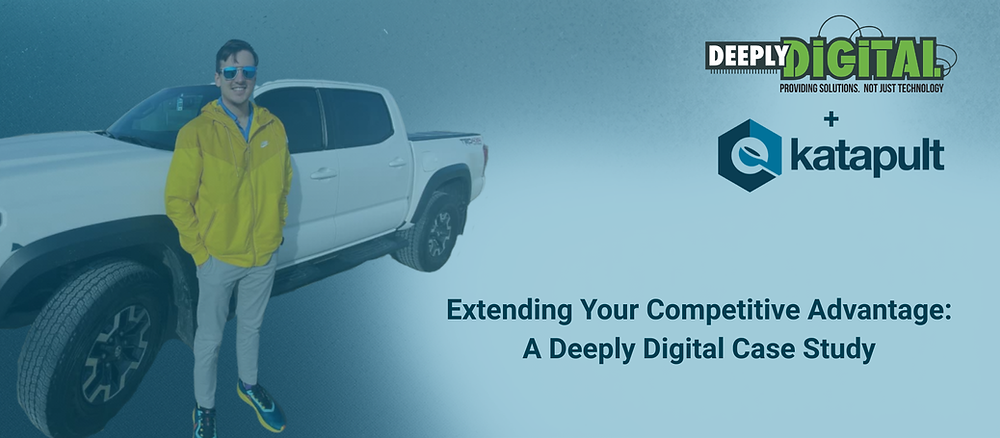
How one team used Katapult Pro’s API to feed their custom application that manages engineering workflows, automates team assignments, tracks KPIs, and turns work-in-progress into operational intelligence.
At a Glance
|
Company |
Deeply Digital |
|
Role |
Brandan Lewis, GIS Developer and OSP Engineering Manager |
|
Scale |
100,000+ poles |
|
Primary Use |
API-driven enterprise application integrating Katapult Pro with GIS and other critical business applications |
|
Key Takeaway |
Deep platform knowledge combined with modern development tools allow Deeply Digital to extend Katapult Pro and maintain a competitive advantage for their engineering operations. |
The Builder
Brandan Lewis has been a Katapult Pro power user since 2018. There was not a single month in that stretch where he wasn’t in the platform.

His career trajectory set him up for this unique skill set. He started at a firm where his background in GIS and software integrations shaped how he saw every tool he touched. From day one, he was looking at it through the lens of how Katapult Pro could be extended, what data could be extracted, and how it could connect to the systems around it.
Early on, that meant exporting shapefiles and running them through FME to automate the creation of AutoCAD construction prints. It meant experimenting with expensive GPS backpacks in three-person field crews for decimeter-resolution data collection. Some ideas were hugely fruitful, and others were dead ends (no pun intended). But every experiment deepened his understanding of what the platform held and what it could power if you pulled the data out and put it to work somewhere else.
When he moved to a VP of GIS role, the stakes got higher. The firm had an existing enterprise application for field data collection and permit generation. Katapult Pro was the most efficient way to collect data and generate engineering deliverables, but the two systems didn’t talk to each other. That’s where the API became essential: Brandan built a two-way integration that synchronized jobs between their custom application and Katapult, creating work orders and tracking deliverables across both platforms.
Brandan would continue to look for ways to use API extensibility to provide integrated services at his own firm, and now with Deeply Digital.
The Foundation
Now he’s at Deeply Digital, a firm specializing in fiber engineering and consulting. Brandan has architected and built an enterprise application that isn’t limited to in-progress pole permitting work—instead, it leverages Katapult Pro data as a piece of a bigger operational hub.
It’s not a Katapult plugin. It’s an independent application with its own business logic, its own interface, and its own connectors. Katapult Pro is one of several data sources that feed into it, alongside ArcGIS, Salesforce, and other systems. But Katapult is the single point of truth for utility design and construction data. Every pole, every field collection status, every job assignment flows through the Katapult API into the hub.
The Katapult Pro API is the pipe that makes all of this work. Brandan self identifies as a API power user and knows exactly where the rate limits are. When Katapult released the V3 API, he refactored everything to use the new endpoints.
“When you guys came out with V3, I refactored everything and it saved me about 50% of compute processing time.”
- Brandan Lewis, GIS Developer and OSP Engineering Manager, Deeply Digital
That kind of performance gain matters when you’re processing data from 10s of thousands of poles. Every percentage point of compute time saved translates into faster syncs, fresher data, and a more responsive system for the teams that depend on it.
What He Built
Their platform takes the constant stream of data flowing out of Katapult Pro and turns it into operational tools that Katapult Pro doesn’t provide natively. This looks like:
-
Katapult Pro data synced with their master GIS
-
Automated team assignments
“All they have to do is just do what they’re doing in Katapult, and I’m able to automatically assign jobs, have them work those jobs, constantly refreshing that data.”
- Brandan Lewis, GIS Developer and OSP Engineering Manager, Deeply Digital
-
Performance tracking and KPIs
-
Quality control analysis
-
Permit and construction tracking
How It Got Built
With new AI development tools, the user database and UX for applications like this can happen very quickly, especially once the API connections are well-understood and established.
“The majority of that application was created in the last two weeks. The project portal, the permit portal, the QC analysis tool.”
- Brandan Lewis, GIS Developer and OSP Engineering Manager, Deeply Digital
That speed is not a fluke. It’s the compounding return on two investments: 18 months of architecture work, and years of deeply understanding how Katapult Pro works. Brandan knows the data model. He knows where attachments are stored, how job statuses flow, what the API returns at each endpoint, and how to trace ownership through nested components. That knowledge is a competitive advantage that can’t be reproduced overnight.
Why It Matters
This is not a story about AI or how Katapult Pro became exactly what Deeply Digital needed to crush their services and operations.
It’s about how SaaS extensibility will pave the way for talented people at innovative firms to build their own competitive advantage on existing tools as technology rapidly evolves. Brandan wants to set Deeply Digital apart by using Katapult Pro and other systems in ways (and at speeds) his competitors can’t.
Katapult Pro was built to be the most efficient way to collect pole data and deliver engineering work. There are a lot of things that it wasn’t built to be. But because the API exposes the data cleanly enough, someone like Brandan can build all of those things on top of it, without waiting for us to catch up (check out our public roadmap), and without giving up any of the platform’s core strengths.
“That’s why I think it’s cool to give a little bit of that flexibility to your users to say, ‘This is how the API works, and this is how you can use it to solve your own problems outside of having to ask us to do it.’”
- Brandan Lewis, GIS Developer and OSP Engineering Manager, Deeply Digital
The tools to build something like this are more accessible than ever. Modern AI coding agents can turn an architect’s vision into working code in hours rather than months. But the vision itself still requires something no AI can provide: years of understanding how poles work, how field crews operate, how utilities think about permits, the art/science of make ready engineering, and how the data inside Katapult Pro maps to the real decisions that drive a business forward.
That combination of deep domain knowledge and an extensible platform is where the next wave of competitive advantage lives. Not inside the software. On top of it.
Ready to see what Katapult Pro can do for your team?
.png?width=680&height=1008&name=pole-no-bg%20(1).png)