.png?width=680&height=1008&name=pole-no-bg%20(1).png)
.png?width=500&height=500&name=Thought%20Leadership%20Template%20(10).png)
BEAD Deployment Challenges: How Municipalities Stay in Control
A vendor just pitched you a LiDAR solution. The demo was impressive—aerial footage, dense point clouds, millions of data points captured per second. The technology clearly works. The question isn't whether LiDAR is powerful. It obviously is. The question is whether it's the right tool for your specific project, your budget, and the deliverables your clients actually need.
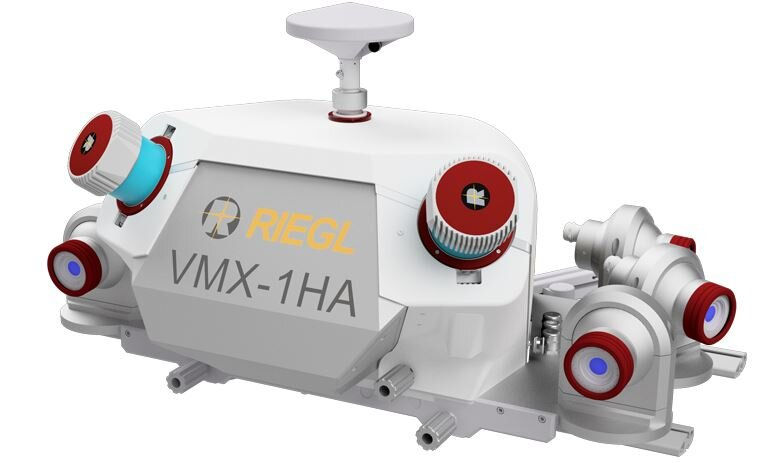
We've been asking that question since the early 2000s. Katapult Engineering purchased a Riegl terrestrial LiDAR scanner nearly three decades ago for OSP data collection. We used it, we learned from it, and eventually, we built our entire platform around a different method (for now). That experience gives us a perspective you're unlikely to get from a LiDAR vendor demo: an honest assessment of where the technology excels, where it struggles, and how to make the right call for your next project.
This guide covers the real trade-offs OSP engineers and project managers need to understand before committing to LiDAR for utility pole surveys, aerial surveys, or make ready engineering workflows. We'll compare it directly against photogrammetry-based collection and give you a practical decision framework for choosing between them. And the day is surely coming where LiDAR will become the best data collection solution for many Katapult Pro workflows.
What LiDAR Actually Is (and How It Works in Practice)
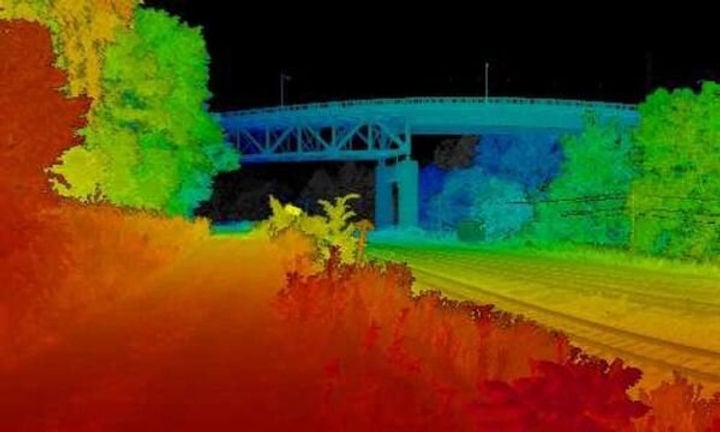
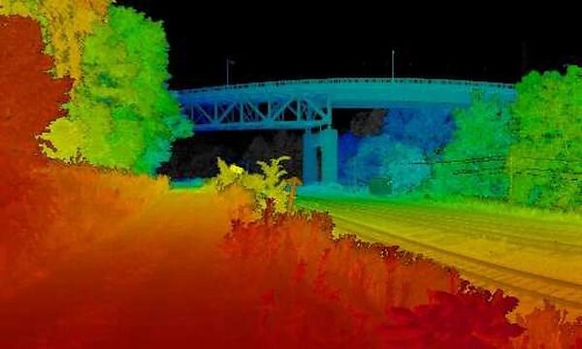
LiDAR stands for Light Detection and Ranging. At its core, it's a measurement system that fires rapid pulses of laser light at a surface and measures how long each pulse takes to return. From that time-of-flight calculation, the system constructs a precise three-dimensional map of everything in its field of view—a point cloud.
Modern terrestrial LiDAR scanners can capture millions of data points per second with sub-centimeter accuracy. Airborne systems mounted on planes, helicopters, or drones can survey miles of corridor in a single pass. Mobile systems mounted on vehicles can scan at highway speeds. The technology has matured significantly since the early commercial systems of the late 1990s, and it's genuinely impressive across a range of survey applications.
In the context of utility infrastructure, LiDAR has found real traction in transmission line corridor surveys, large-scale asset inventory projects, and scenarios where traditional ground-level access is difficult or dangerous. For these applications, the argument for LiDAR is straightforward: you can collect massive amounts of precise spatial data without putting crews at risk.
The complications arise when you start applying LiDAR to the specific requirements of distribution pole surveys for OSP engineering. That's where the trade-offs become material.
The Real Advantages of LiDAR for OSP Applications
Safety in Difficult Access Situations
The original reason we purchased a LiDAR scanner was safety. For surveying limited-access highway crossings, railroad rights-of-way, or energized substations, LiDAR genuinely solves a problem that no other technology handles as cleanly. Instead of sending a crew into a dangerous environment to manually measure each structure, you can capture the data from a safe distance.
Airborne and mobile LiDAR systems extend this advantage further. Vehicle-mounted systems have scanned tens of thousands of distribution poles at highway speeds without a single crew member needing to approach live infrastructure. For projects where crew safety is the primary constraint, LiDAR's standoff capability is a legitimate differentiator.
Speed at Scale for Corridor Surveys
When the project calls for capturing the current state of a long linear corridor—hundreds of miles of transmission line, for example—LiDAR's throughput is difficult to match. An airborne LiDAR system can survey miles of infrastructure in hours. Processing time is significant, but the raw data acquisition speed is genuinely impressive.
For large-scale asset inventory projects where the goal is a snapshot of existing conditions across a wide area, LiDAR can establish a baseline dataset faster than any ground-based collection method.
Accuracy for Spatial Measurements
Modern LiDAR scanners achieve accuracy in the range of 5-15mm at close to medium range. For applications that require precise spatial measurements across large spans—catenary curve analysis, conductor sag modeling, or detailed terrain mapping—LiDAR's accuracy and density of coverage are hard to beat. The ability to capture thousands of points along a span rather than a handful of discrete measurements opens up analytical possibilities that simply aren't available with traditional methods.
The Real Limitations of LiDAR for Distribution Pole Surveys
Here's where the vendor demo usually ends and reality begins. The limitations of LiDAR for distribution-scale OSP pole attachment work are specific and significant.
Point Cloud Data Requires Human Interpretation at the Pole Level
LiDAR captures geometry. It does not capture identity. A point cloud of a utility pole shows you the three-dimensional shape of what's on that pole. It does not tell you who owns each cable, what type of conductor it is, whether that communication bundle is fiber or coax, or what the pole class and species/treatment are. All of that contextual information—which is essential for pole loading analysis and make ready engineering—still requires human interpretation.
The parallax problem is real and underappreciated. When analyzing point cloud data for specific cable heights, a technician selecting points from the cloud can choose incorrect returns. The laser doesn't know the difference between a cable and a piece of equipment. Dense canopy, multiple attachment layers, and complex wire configurations create ambiguity that software algorithms can reduce but cannot eliminate. Single data returns have meaningful uncertainty baked in; truth emerges from statistical analysis of large volumes of returns, not from individual point selections.
Base-of-Pole Data Still Requires Physical Access
This is the practical deal-breaker for many distribution pole projects. If your scope includes collecting birthmark data—pole class, height, species, treatment date, manufacturer tag—a human still needs to walk up to each pole and read it. Airborne or mobile LiDAR cannot read the tag nailed to the pole at shoulder height. It cannot tell you the circumference at groundline if there is brush around the pole. If circumference data is required for pole loading calculations, the efficiency advantage of aerial LiDAR disappears: you're paying for both the LiDAR pass and the ground crew.
Similarly, any scope that requires identifying specific attacher ownership, recording equipment specifications, or documenting ground-level conditions will still require field crews. LiDAR augments that work; it rarely replaces it for distribution-scale pole attachment surveys.
Processing Overhead Is Significant
The point clouds that LiDAR generates are enormous. A single airborne survey of a meaningful corridor can produce terabytes of raw data. Processing that data into usable deliverables requires specialized software, significant compute resources, and trained analysts who understand how to interpret point cloud data in the context of utility infrastructure. Most utilities and OSP engineering firms do not have this capability in-house, which means subcontracting the processing step—adding cost, adding time, and adding a handoff in the workflow.
This is not a hypothetical concern. When we used LiDAR for OSP collection, the back-office processing burden was substantial. The field acquisition was fast; the path from raw scan to usable engineering data was not.
Cost Structure Doesn't Scale to Standard OSP Projects
A capable terrestrial LiDAR system runs $100,000 or more for the hardware alone. Airborne systems are priced higher still, typically deployed as contracted services with mobilization costs that make economic sense only for large projects. When you work through the math on a per-pole basis for a standard 200-500 pole make ready project, the cost structure frequently doesn't provide a positive ROI.
The question to ask before committing to LiDAR is whether the project volume and complexity justify the capital or service cost when measured against alternative collection methods that can deliver equivalent or superior deliverables for the specific scope.
LiDAR vs. Photogrammetry: A Practical Comparison for OSP Work
Most distribution pole attachment projects today are using one of two primary data collection methodologies: LiDAR or photogrammetry. Understanding the trade-offs clearly helps you match the method to the scope.
Photogrammetry for pole collection involves capturing calibrated photographs of each pole—a height shot taken with a precisely calibrated lens, plus supplementary shots for equipment, tagging, and midspan conditions. Software then extracts measurements from those photographs with known accuracy (typically within 3 inches at heights up to 50 feet). The resulting data directly supports third-party attachment applications, make ready engineering, and pole loading analysis without a separate processing step.
The core differences come down to a few practical dimensions:
Per-pole cost. Photogrammetric collection with a trained two-person crew typically runs $25-$100 per pole depending on access conditions and project density. LiDAR service costs vary widely but often run higher for standard distribution pole surveys when processing is included. As a reminder, this does not include make ready engineering or construction package preparation.
Birthmark data capture. Photogrammetry done at pole level captures birthmark data as part of the same visit. LiDAR cannot read pole tags and generally requires a separate ground-truth step for specification data.
Data processing pipeline. Photogrammetric data collected in Katapult Pro is available for office engineering work after upload at the end of the day without a separate processing pipeline. Point cloud data from LiDAR requires post-processing before it's usable in engineering workflows.
Deliverable flexibility. Photogrammetric data collected in a platform like Katapult Pro can be exported directly to external platforms for loading analysis—or used natively for make ready engineering and pole loading without platform switching. LiDAR-derived data typically requires additional transformation steps before it can feed standard engineering tools.
Accessibility. Photogrammetric collection can be performed by trained two-person crews without specialized equipment. LiDAR requires either significant capital investment or contracted specialty services.
Neither method is universally superior. The question is which method fits the specific project requirements.
When to Use LiDAR and When to Use Photogrammetry
Choosing between LiDAR and photogrammetric collection comes down to honest scope analysis. Here's a practical framework.
LiDAR makes sense when: your project involves a large corridor survey where the primary goal is capturing existing spatial conditions at scale; access to individual poles is difficult or dangerous; the analysis required focuses on geometric relationships (sag, clearance between spans) rather than attacher-level detail; and your team has or can contract the processing capability to turn raw point cloud data into usable deliverables.
Transmission line corridor surveys, large-scale asset inventory programs, limited-access crossing surveys, and projects where a snapshot of existing conditions is the primary deliverable are reasonable candidates.
Photogrammetry makes sense when: your project scope includes third-party attachment applications, make ready engineering, or pole loading analysis; you need attacher ownership and equipment specification data; your deliverables need to feed directly into standard engineering tools without additional processing; and you need to scale collection across a large number of poles with predictable per-pole economics.
Standard distribution pole attachment surveys, make ready engineering projects, joint use audit programs, and broadband deployment workflows that need to move quickly from field collection to engineering decisions are well-suited to photogrammetric methods.
Hybrid approaches are increasingly common for larger programs. LiDAR provides a corridor-level spatial baseline; targeted photogrammetric collection at specific poles captures the attacher-level detail that LiDAR can't deliver. The challenge is managing two data collection workflows and ensuring they integrate cleanly downstream.
Your data collection method shapes every engineering decision downstream. If you're evaluating collection approaches for an upcoming project, our team can walk you through the trade-offs specific to your scope.
Common Mistakes When Evaluating LiDAR for OSP Projects
Several patterns consistently lead to poor decisions when teams are evaluating LiDAR for distribution pole work.
Evaluating based on the technology rather than the deliverable. LiDAR is impressive technology. That's not the right evaluation criterion. The right question is: what does the project actually need to deliver? If the deliverable is make ready engineering packages, work backward from that requirement to determine which data collection method most efficiently produces the inputs those packages require.
Underestimating processing costs and timelines. The hardware and flight costs for airborne LiDAR are often the numbers in vendor proposals. Processing costs and timelines are frequently underestimated or excluded. A complete cost comparison needs to include data processing, quality control, and the time from field acquisition to usable engineering data.
Assuming LiDAR eliminates field crews. For most distribution pole attachment scopes, it doesn't. Base-of-pole data, birthmark information, and attacher identification still require physical access. The remaining poles are the slowest and most expensive to collect.
Conflating accuracy with defensibility. LiDAR generates highly accurate spatial data, but accuracy alone doesn't make data defensible in pole loading disputes or make ready negotiations. Defensible data is data that can be tied to a specific pole, a specific date, and a clear chain of custody—the kind of documentation that holds up when an attacher disputes a make ready call. Photo-based collection builds this documentation record natively; point cloud data typically requires additional workflow steps to achieve equivalent defensibility. This matters especially for utility pole inspection programs where data auditability is part of the program requirement.
Frequently Asked Questions About LiDAR for Utility Pole Surveys
Q: Is LiDAR accurate enough for pole loading analysis?
LiDAR can achieve the spatial accuracy required for pole loading models, but accuracy is only part of the requirement. Pole loading analysis also needs attacher identification, equipment specifications, pole class and height data, and guying information—much of which LiDAR cannot capture from a distance. Teams typically still need ground-level data collection to complete a loading model, which changes the efficiency equation significantly.
Q: Can LiDAR capture pole tag and birthmark data?
No. Reading the tag on a utility pole requires physical proximity. Airborne and mobile LiDAR systems capture geometric data; they cannot read the manufacturer's tag, record the circumference at six feet, or identify the species and treatment class of the pole. If your scope requires this data—and most make ready and loading analysis scopes do—a ground-level collection step is required regardless of LiDAR use.
Q: How does LiDAR compare to photogrammetry for cost on a standard make ready project?
For a standard 200-500 pole make ready project on a distribution system, photogrammetric collection is typically more cost-effective when full processing costs are included for LiDAR. LiDAR's cost advantages emerge at scale—long corridors, large inventory programs—where its throughput justifies the higher per-unit processing overhead. Your specific economics will depend on project density, access conditions, and whether you're deploying owned equipment or contracted services.
Q: What data can photogrammetry collect that LiDAR can't?
Photogrammetric collection at the pole level captures attacher ownership labels, equipment manufacturer and specification data, pole birthmark information (class, height, species, treatment), tag numbers, and visual condition indicators that don't produce a clean LiDAR return. It also produces a photographic record that can be reviewed remotely and used to adjudicate disputes—something point cloud data doesn't provide in the same way.
Q: Is drone-based LiDAR a game-changer for distribution pole surveys?
Drone LiDAR has improved significantly and is increasingly used for transmission corridor surveys and targeted spot inspections. For standard distribution pole surveys in vegetated or urban environments, the limitations around canopy penetration, FAA flight restrictions in congested airspace, and the continuing need for ground-level birthmark collection mean that drone LiDAR hasn't displaced traditional collection methods for most distribution attachment scopes. It's a useful tool for specific situations, not a universal replacement.
Q: How does Katapult Pro handle data collection for pole attachment projects?
Katapult Pro uses calibrated photogrammetry—field crews capture standardized photos of each pole using calibrated equipment, and the platform extracts measurements accurate to within 3 inches at heights up to 50 feet. That data feeds directly into make ready engineering and pole loading workflows without a separate processing step, and exports cleanly to SPIDAcalc, O-Calc Pro, and PoleForeman. The platform captures the full scope of data needed for attachment applications: heights, ownership, equipment specifications, pole specifications, and geospatial location.
Q: Can LiDAR data be used in Katapult Pro?
Katapult Pro is primarily built around photo-based data collection, which produces the attacher-level detail that most distribution attachment scopes require. For teams exploring hybrid approaches that incorporate LiDAR-derived spatial data alongside traditional collection, the best path is to reach out directly to discuss your specific project requirements and data sources. We believe LiDAR integration is a likely future for the platform.
Making the Right Call for Your Project
LiDAR is genuinely powerful technology. It belongs in the toolkit of any team doing large-scale infrastructure surveys, transmission corridor work, or projects where crew safety is the binding constraint on data collection method.
We built Katapult Pro's data collection workflow around photogrammetry because, after using LiDAR for OSP collection, we found that calibrated photo collection gave our engineering team what they needed faster, at lower cost, and with better defensibility for the attachment and make ready work that drives most distribution projects. That conclusion was earned through direct experience.
If you're evaluating data collection methods for an upcoming project and want a direct conversation about trade-offs, our team is glad to help you think it through.