

.png?width=680&height=1008&name=pole-no-bg%20(1).png)
.png?width=500&height=500&name=Thought%20Leadership%20Template%20(10).png)
BEAD Deployment Challenges: How Municipalities Stay in Control
Next time you drive through a suburban neighborhood, pick a pole at random and count the wires on it. There's probably primaries up top, a neutral strung below that, and somewhere between one and six communications attachments stacked lower on the pole. Depending on where you're standing you might also see a streetlight head, a transformer can, or a down guy pulling the whole thing. That equipment, most of it owned by different companies, all hanging off the same piece of wood or steel, is the reality of modern distribution.
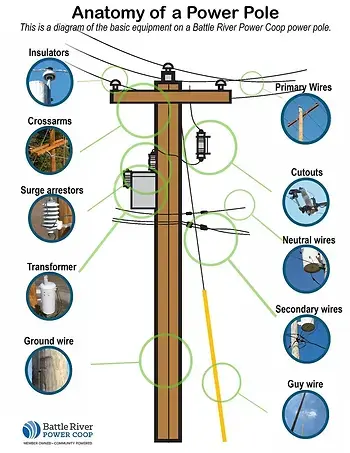
Distribution poles are the last leg of how electricity reaches your house, your office, and the coffee shop down the street, and they're also the primary pathway for broadband, cable, and fiber into those same buildings. Because they carry so much more than just power, the process of managing what goes on them, how it gets there, and who pays for what is one of the trickier coordination problems in infrastructure.
This guide walks through what distribution poles actually are, what gets attached to them, who owns what, and why managing all of it is harder than it looks. If your work touches distribution poles in any way, whether that's field data collection, engineering, joint use, or pole attachments, this is meant to give you a useful foundation.
See how Katapult Pro supports pole data workflows from the field to the desktop.
What Is a Distribution Pole?
A distribution pole is the workhorse of the power grid. After electricity leaves a generating plant, it travels across high-voltage transmission lines, gets stepped down at a substation, and enters the distribution network at a medium voltage. From there, distribution poles carry that electricity across neighborhoods until transformers step it down again to the low voltages that serve individual homes and businesses.
A distinction worth making upfront: transmission structures (the big lattice towers or large monopoles you see along highway corridors) typically carry voltages in the hundreds of kilovolts and are almost always owned and exclusively used by a single utility. Distribution poles are smaller, shorter, and closer to the end user, and they carry medium voltages under shared ownership arrangements. The utility that owns the pole rarely uses the whole pole by itself.
That shared nature is what makes distribution poles the center of gravity for joint use/joint ownership work. Telecom providers, cable companies, fiber ISPs, and municipal services all attach to distribution poles under various agreements with the pole owner, and every new attachment triggers a series of engineering and permitting steps that the utility has to coordinate. Multiply that across thousands of poles in a typical utility footprint and the complexity compounds quickly.
Anatomy of a Distribution Pole
A distribution pole is vertically organized. Different types of equipment occupy different zones, and those zones exist for good reasons that come back to safety, maintainability, and regulatory clearance requirements. Working from the top down, here's what you'll typically find.
The Supply Space
The supply space sits at the top of the pole and holds the electrical conductors. This is the highest-voltage zone on the pole, and only electric utility workers with appropriate training and equipment should operate in it. You'll often see three phase conductors (sometimes on a crossarm, sometimes in a triangular configuration), possibly a neutral, and any associated hardware like insulators, transformers, fused cutouts, and lightning arrestors. Transformers are the big cans you see on poles, stepping voltage down to serve nearby customers.
The Safety Zone
Below the supply space is a vertical buffer, often called the safety zone or communications worker safety zone. This space is intentionally kept clear so that communications workers operating below can do their jobs without getting too close to energized power equipment. The exact required clearance is governed by the National Electrical Safety Code (NESC) and varies based on voltage class and conditions, but the principle behind it is consistent: power equipment and communications equipment have to stay separated by a predictable, code-required distance.
The Communications Space
Below the safety zone is where third-party attachments live. Telephone, cable television, fiber, and other communications infrastructure get attached here, and multiple companies often share this space, stacked vertically according to attachment order and pole owner rules. Working in the communications space still demands care, but it doesn't require the same training and equipment as the supply space.
Hardware and Accessories
Beyond the main zones, a distribution pole carries a lot of other hardware. Crossarms extend horizontally to support conductors, insulators hold conductors away from the pole, and guys and anchors keep the pole stable at corners, dead-ends, and tall spans. Streetlights mount to the pole and draw power from a dedicated service, while risers carry conductors up the side of the pole from underground. The pole itself has a birthmark (the stamped or branded tag indicating height, class, and species) near the base that tells you what you're dealing with structurally.
Getting reliable data on all of this is the starting point for nearly every downstream engineering decision, which is why accurate pole data collection is so foundational to the work.
Pole Materials and Classes
Not all distribution poles are built the same way, and the differences matter when it comes to loading, maintenance, and replacement cycles.
Wood poles are still the most common in the United States. They're typically southern yellow pine or Douglas fir, pressure-treated for rot resistance, and they come in standardized height and class combinations. Wood is relatively inexpensive, easy to climb, and easy to modify in the field, which keeps a lot of utilities defaulting to it for routine work. Wood also rots, gets hit by woodpeckers, and loses strength over time, so utilities run pole inspection programs on regular cycles to catch failures before they happen.
Steel poles are gaining ground in areas where wood rot or fire risk is a concern. They're stronger, last longer, and don't decay in the same way wood does, but they're more expensive and require different maintenance considerations once they're in the ground.
Composite (fiberglass) poles are lighter than wood or steel and resistant to corrosion, rot, and insects. They're especially useful in coastal environments or remote locations where transporting heavier poles is a logistical challenge.
Concrete poles show up more in industrial settings and some rural contexts. They're heavy, durable, and low-maintenance, but they're also hard to modify once they're in the ground.
Within each material, poles are specified by height and class. Height is straightforward (30 feet, 40 feet, 45 feet, and so on). Class is a standardized rating that reflects the pole's strength at the groundline, where a lower class number indicates more strength. Those two numbers together drive most of what an engineer can or can't do with a given pole when calling make ready or planning a new attachment.
What Gets Attached to a Distribution Pole
Anyone who's spent time looking at distribution poles will recognize the list. From top to bottom:
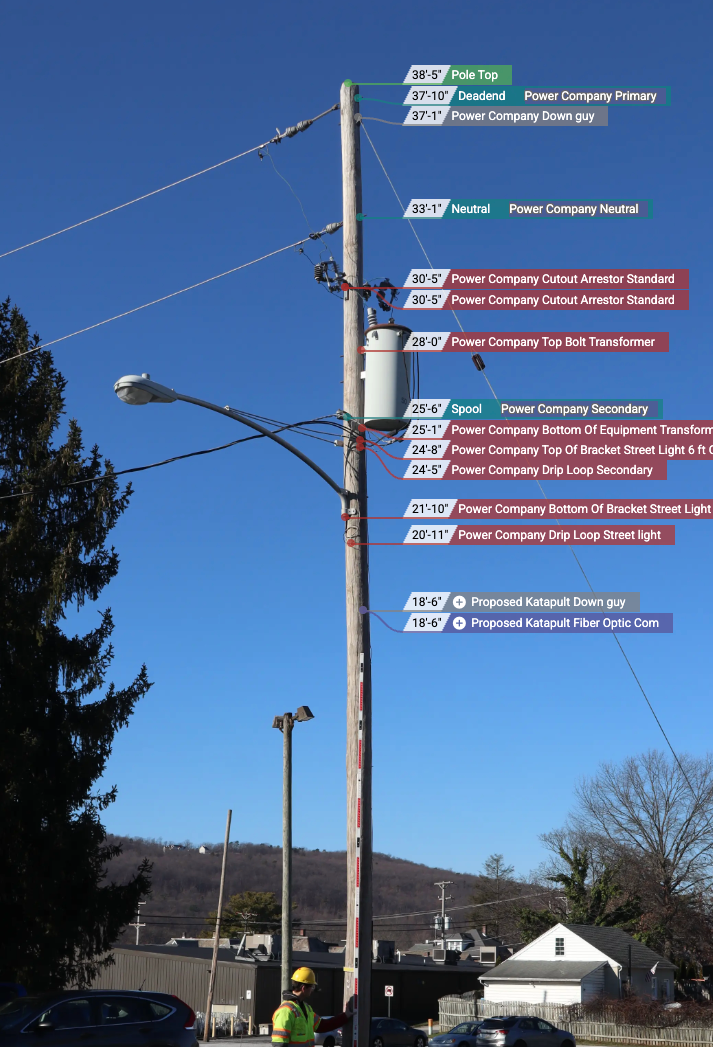
Electric utility equipment. Conductors, neutral, transformers, switches, capacitors, reclosers, fused cutouts, and any associated hardware all belong to and are operated by the electric utility, which is almost always the pole owner.
Streetlights. These are sometimes owned by the utility, sometimes by the municipality, and sometimes by a third party under a lease arrangement. The billing and maintenance structure depends entirely on local arrangements.
Third-party communications attachments. This is where it gets crowded. You'll usually find incumbent local exchange carriers (ILECs) like the legacy phone companies alongside cable television providers, competitive local exchange carriers (CLECs), and fiber-to-the-home (FTTH) providers. Wireless backhaul and municipal networks show up on many poles, and in denser areas you'll also see small cell or DAS nodes claiming their own vertical space. Each of these sits at a specific height in the communications space, determined by when they attached and what the pole owner's rules allow.
Other equipment. Pole-mounted antennas, cameras, sensors, and various smart grid devices increasingly appear on distribution poles. As more is expected from the grid and from connected infrastructure, the pole itself is becoming a convenient mounting point for a lot more than wires.
The practical consequence of all this is that a typical distribution pole in a developed area has something on it from three to six different owners, and every one of those attachments got there through a permitting and engineering process.
Who Owns the Pole and Who Attaches to It
In the vast majority of cases, distribution poles are owned by the electric utility that serves the area, whether that's an investor-owned utility (IOU), a rural electric cooperative, or a municipal utility. In some regions, telephone companies co-own poles with electric utilities under long-standing joint ownership arrangements, and in certain markets the incumbent telephone company is the sole pole owner.
The pole owner holds the responsibility for the pole itself. They maintain it, inspect it, replace it when it fails, and ultimately carry the liability if it falls down. They also set the rules for who can attach to it and under what conditions.
Everyone else on the pole is an attacher. Attachers don't own the pole, they own their equipment, and they pay the pole owner a per-attachment annual fee (often called a pole rental fee or attachment fee) for the privilege of using the pole's space. They also pay for make ready work when their new attachment requires changes to the pole or to existing equipment.
The relationship between pole owners and attachers is often called joint use. Joint use is the bucket that covers attachment applications, fee negotiations, compliance audits, safety concerns, and the coordination required to keep a shared pole functioning safely. Joint use teams at utilities are often small relative to the workload they're carrying, especially in periods of heavy broadband buildout.
The Rules of the Pole
Distribution poles don't operate under a single set of rules. They operate under several overlapping regimes, and any attacher working on a utility's footprint has to stay compliant with all of them.
The National Electrical Safety Code (NESC) is the primary technical standard in the United States. It governs how equipment can be arranged on a pole, what clearances are required between different classes of equipment, and what loading a pole has to be able to withstand. State Public Utility Commissions typically adopt the NESC with or without amendments, so it carries legal weight. California uses General Order 95 (GO 95) instead, which covers similar ground.
FCC Section 224 governs pole attachment rates and terms in most states. When a telecom company attaches to an electric utility pole, Section 224 sets the framework for what the utility can charge and how disputes get resolved. States that have reverse-preempted the FCC set their own rules, but the underlying framework of regulated rates, non-discriminatory access, and reasonable timelines is similar.
Utility-specific standards. Every pole owner has their own construction standards that build on top of NESC or GO 95. These specify things like the order of attachments in the communications space, required hardware, clearance margins beyond code minimums, and acceptable methods for specific situations. Attachers have to build to whichever utility's standards apply on a given pole.
Municipal and DOT requirements. When a pole sits in public right-of-way, local or state transportation authorities may have input, and pole permitting processes layer on top of everything else. That's especially true in DOT right-of-way or near railroads, where additional reviews can add weeks to a timeline.
Any new attachment has to clear all of these hurdles. Make ready engineering is the process of figuring out what work is needed on a pole to accommodate a new attachment while staying compliant with everything above.
Why Managing Distribution Poles Is Harder Than It Looks
From a distance the system looks simple enough: a pole goes in the ground, equipment gets attached to it, and the utility manages the whole arrangement. On any given pole the reality is a lot more tangled than that picture suggests, for a few reasons worth spelling out.
Replacement work drags every attacher along with it
When the pole owner needs to replace a pole because of damage, deterioration, or capacity issues, every attacher on that pole has to transfer their equipment to the new one. Coordinating those transfers across three to six different companies, each with their own work schedules and priorities, is difficult on the best day and a nightmare on most others. When transfers stall, you get double wood conditions where two poles sit side by side for months or even years, because the old pole can't come out until the last attacher moves, and that last attacher often has no particular incentive to hurry.
Data quality is uneven
Pole records were historically kept on paper, then on spreadsheets, then on various mismatched systems, so utilities often don't have a reliable, complete inventory of what's actually on every one of their poles. Field conditions drift from records over time as new attachments get added without paperwork and old equipment gets left behind. When an engineering decision gets made against records that don't match reality, that decision is often wrong before the crew even leaves the parking lot.
Attachment volume has exploded
Broadband funding programs, 5G deployment, and general demand for faster connectivity have driven attachment applications to levels most joint use departments weren't staffed for. A team of two people might be processing hundreds of applications a month, each of which requires field verification, engineering review, and construction coordination before a single attachment gets installed.
The cost recovery math is hard
When a pole needs to be replaced because it can't hold another attachment, someone has to pay for the replacement, and figuring out who varies widely from project to project. The responsible party might be the attacher who triggered the application, the group of existing attachers now benefiting from the new pole, or the utility itself, depending on jurisdiction, contract, and circumstance. Even when forensic analysis can identify who caused a loading problem, recovering those costs from the responsible party is often difficult in practice. That gap between "who caused the cost" and "who can realistically be billed for it" is a hard operational reality in make ready work.
Safety is non-negotiable
Every decision on a distribution pole happens under the constraint that a mistake can kill someone. Linemen have one of the most dangerous jobs in the country, pole loading has to account for ice storms and wind events and equipment fatigue, and clearances exist because people died before the industry figured out they needed to. Nothing about this process gets rushed without paying for it somewhere, which is why experienced teams build margin into schedules even when the customer is pushing back.
These factors compound on each other. Bad data makes coordination harder because nobody can agree on what's actually on a pole, and those coordination gaps generate backlogs that push everyone toward shortcuts they'd rather not take. Safety still has to hold while the industry tries to catch up with its own workload.
Drowning in attachment applications or make ready backlog? Katapult Pro organizes pole data, streamlines make ready engineering, and gives every party real-time visibility into where things stand. The platform was built by an OSP engineering team that calls make ready every day, so it reflects how the work actually happens rather than how a software vendor imagines it does.
How Distribution Poles Fit into Field-to-Office Workflows
Most of the work on distribution poles happens in a rough sequence: gather information from the field, make engineering decisions in the office, deliver a package to construction, inspect the results, and update records. Every stage depends on the accuracy of the previous one, which is why weak spots early in the workflow tend to cost real money by the time the consequences show up downstream.
Field data collection is where it starts. Crews go out to a set of poles and capture the physical reality, which means pole location, pole specs, attachment heights, equipment condition, span lengths, midspan clearances, guying, and photos of everything that matters. Modern data collection platforms let field crews do this from ground level with photogrammetry, which is safer and faster than climbing. Field data collected this way stands up to disputes and audits because every photo and measurement is tied to a specific pole with timestamps and true geolocations.
Engineering review takes the field data and uses it to make design calls. For a new attachment, that means running pole loading analysis to confirm the pole can handle the new load, checking clearances against code, identifying required make ready moves, and producing a construction package that tells crews exactly what to do. Engineers typically use tools like SPIDAcalc, O-Calc Pro, or an integrated loading engine to verify the pole is safe under expected load cases.
Joint use coordination runs in parallel with engineering. If make ready work is required, every affected attacher needs to be notified, given time to comment, and eventually asked to move their equipment. Applications flow through workflow systems, statuses update, timelines tick down against FCC shot clocks, and everyone involved needs visibility into what's happening and what's next.
Construction executes the plan by building what the engineering package specifies, ideally working from the same data the engineer used so nothing gets misinterpreted in translation. Post-construction inspections then verify that what was built matches what was designed.
Records update last. When the work is done, the pole's records should reflect the new reality, which means attachment inventories get updated, GIS catches up with the field, and pole inspection histories include the pole's new state. In practice this last step gets skipped more often than anyone in the industry wants to admit, and that's where most long-term data drift originates.
The full cycle works best when every stage shares a single source of truth about each pole. When field data, engineering notes, attachment records, and construction outcomes all live in different systems, drift creeps in between them, and that drift generates the kind of coordination failures described earlier.
Where Katapult Pro Fits
Utility enterprise systems like GIS, asset management, and work management platforms are designed to be systems of record. They hold what the utility has officially documented, but that documentation is only as current as the last update, and updates often lag field reality by months or years.
Katapult Pro sits between field reality and those enterprise systems as a work-in-progress layer. It's where new pole data is collected, where make ready and pole loading decisions get made, where attachment applications get processed, and where the current state of any pole can be verified before anything else happens. When a project wraps, clean, validated data flows back to the utility's systems of record on the utility's terms.
Three capabilities matter most for distribution pole work:
Data Collection lets field crews capture everything about a pole (location, specs, attachments, photos, midspan measurements) from ground level, with photos calibrated for accurate height measurement. The data is defensible, timestamped, and tied to true geolocations, so it holds up when a utility or attacher pushes back on what was captured.
Engineering Design runs make ready and pole loading analysis against the field data, auto-flags clearance violations against NESC or GO 95 rules, and builds construction packages. Utility-specific standards can be imported and adjusted so designs match the rules on a given pole owner's footprint, and SPIDAcalc integration means no one is locked into a single loading tool.
Joint Use Management handles the application side with attacher-facing portals, workflow automation, FCC timeline tracking, notifications, dashboards, and reporting. It also supports double wood resolution workflows for the backlog of stub poles that accumulate when transfers stall.
All three share a single database, so the pole collected in the field becomes the same pole engineered against and later coordinated on, without format conversions or manual re-entry between teams.
Frequently Asked Questions
What is a distribution pole? A distribution pole is a utility pole that carries medium-voltage electrical conductors and associated equipment, delivering power from substations to neighborhoods and buildings. Distribution poles also typically carry communications attachments like telephone, cable, and fiber under joint use arrangements with the pole owner.
What is the difference between a distribution pole and a transmission pole? Transmission poles and towers carry high-voltage electricity over long distances between power plants and substations. They're taller, more robust, and generally used only by a single electric utility. Distribution poles are shorter, carry medium voltages, sit in neighborhoods, and usually host attachments from multiple companies including telecom providers.
Who owns distribution poles? Most distribution poles are owned by the local electric utility, which can be investor-owned, cooperative, or municipal. In some regions, poles are jointly owned by an electric utility and a telephone company. Everyone else who attaches to the pole is an attacher, not an owner, and pays the owner an attachment fee.
What is attached to a distribution pole? A typical distribution pole carries electrical conductors, a neutral, and utility equipment in the supply space at the top, a safety clearance zone below that, and third-party communications attachments (phone, cable, fiber, wireless) in the communications space below. Streetlights, guys, transformers, and various pole-mounted hardware round out the picture.
What is joint use on a distribution pole? Joint use refers to the shared use of a distribution pole by the pole owner and multiple third-party attachers. It covers the rules, rates, applications, engineering, construction coordination, and ongoing maintenance that govern how everyone's equipment coexists on the same piece of infrastructure.
How are pole attachment rules set? Technical rules come primarily from the National Electrical Safety Code (NESC) in most states, or General Order 95 (GO 95) in California. FCC Section 224 governs pole attachment rates and terms in most states, with some states setting their own rules under reverse preemption. Each pole owner also maintains construction standards that attachers must follow.
Why is managing distribution poles difficult? Distribution poles are shared infrastructure with mismatched record systems, growing attachment volumes, complex coordination requirements, and safety constraints that don't allow shortcuts. Pole replacements trigger transfer coordination across every attacher, which can create double wood backlogs when transfers stall, and bad data compounds every one of these problems.
Ready to Bring Order to Your Pole Data?
Distribution poles are shared infrastructure, and shared infrastructure is only as reliable as the data and coordination behind it. When records line up with field reality, engineering decisions hold up under scrutiny, make ready calls stay defensible when they're challenged, and attachment applications can move through review without getting kicked back for rework. When records and the field have drifted apart, which happens more often than most utilities want to admit, every downstream process ends up paying the cost of that drift in rework, delay, or worse.
Katapult Pro is the work-in-progress layer between field reality and the utility's systems of record, bringing field data, engineering design, and joint use management into one platform built by an OSP engineering team that does this work every day.
Schedule a call with our team to see how Katapult Pro fits your distribution pole workflows.