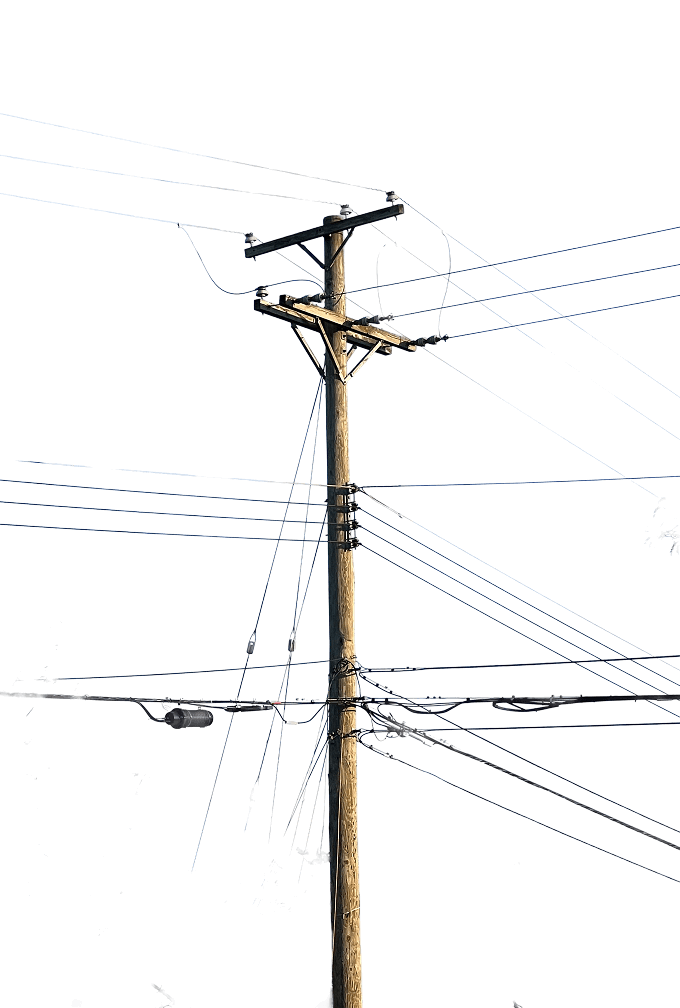
Ask five clients what they need from a pole survey and you'll hear five different answers. One wants an attachment count before the next billing cycle. Another needs aerial permitting submissions, a third wants stamped loading analysis on every pole in the route, and the fourth has a railroad crossing in the middle of the job and a permit desk that won't move until the clearance profile is right. The fifth isn't sure yet, which is its own kind of answer.
The list of final deliverables in this industry is long, and it gets longer every time a pole owner revises its attachment standards or adds a new reliability initiative. But the field work behind those deliverables is a much shorter list. Most distribution pole data collection falls into one of four scopes, and once you know which scope a deliverable needs, you know a lot about how the work should be collected, how much back office time it carries, and how hard the client is going to push on price.
That last part is where proposals go sideways. Quote an engineering scope too low and the margin is gone by the first rear easement pole. Quote an inventory too high and you'll lose to a lower bid. Both mistakes come from pricing the pole when the client is really buying the deliverable.
This guide walks through the four scopes, why price sensitivity drops as you move up them, a few published ballpark price ranges, and how to write a proposal so the comparison happens on the deliverable. If your team collects in Katapult Pro, the same photo set can feed more than one of these scopes, which matters when a project's deliverable changes halfway through.
The four scopes behind most distribution pole work
A data collection scope is defined by two things: what the crew captures at the pole, and what the back office has to do with it before anyone can use it. Each step up the ladder adds field time per pole and adds office work, and each one supports a narrower deliverable with more riding on it.
Rapid Inventory
Rapid Inventory typically involves no measurements. The point is to audit or augment the utility's existing records: pole counts, equipment types, attachments, and locations. The crew finds the pole, captures the photos the client asked for, confirms what's on it, and moves on.
This is the scope behind most joint use attachment audits, where the pole owner is reconciling what's actually on its poles against what it's billing for, and it shows up in double wood surveys and asset inventory work too. Even at this level, the photo earns its keep. Audit findings get disputed, and a dated photo of the pole settles the question faster than a field note. Our post on utility pole audits covers how that work runs at volume.
Basic Measurements
Basic Measurements add attachment heights, and that one addition changes the cost profile on both ends of the job. Collection is slower because the crew has to capture a measurable image (with photo-based methods, a calibrated height shot with a reference stick flush against the pole) instead of a simple confirmation photo. Then the back office has to extract the heights, which is real labor that Rapid Inventory never carried.
This scope supports permit applications that ask for existing attachment heights, clearance screening across a large system, and triage work where the goal is to flag which poles need a full engineering look. Our photo-based collection field guide walks through the height shot in detail, including the calibration mistakes that quietly add error at the top of the pole.
Engineering Design
Engineering Design is where the scope starts to follow the analysis. On top of heights, the crew captures guying and anchors, neighboring poles, pole specifications, midspan heights, and the other inputs that make ready engineering and pole loading analysis depend on. Some of that data comes from poles that aren't even in the application, because the engineering decision on one pole depends on the spans and structures around it.
Pole owners set the floor here, and they set it differently. Whether it's from the applicant or the engineering vendor, pole owners often ask for attachment heights at the pole and at midspan, conductor sizes, pole height and class, pole condition, and guying, with loading analysis run in O-Calc Pro, SPIDAcalc, or PLS-CADD.
Another pole owner will want a different export, a different loading tool, or a tighter limit on how old the field data can be when the application lands. Our guide to pole loading analysis covers what those tools need from the field.
Advanced Modeling
Advanced Modeling captures full corridors, sag profiles, ambient temperature, and the other conditions a narrow set of deliverables demand: transmission under-crossings, railroad right-of-way work, highly specific pole loading analysis, and similar applications.
The reason this scope exists is that a midspan measurement is a snapshot of one moment. Conductor sag changes with temperature and loading, so the clearance you photograph on a cool morning isn't the clearance on a hot afternoon with the line under load, and clearance rules are written against specific conductor conditions. Railroads spell this out. BNSF's utility accommodation policy asks for plans stamped by a Professional Engineer, with a profile showing the wire attachment height and anticipated maximum sag. Norfolk Southern references top-of-rail clearance at 60 degrees Fahrenheit and expects the profile to account for wire type and thermal variation. Capturing ambient temperature at the time of collection is what lets an engineer translate the measured sag into the condition the reviewer actually cares about.
Corridor capture often means LiDAR or survey-grade methods, paired with ground collection at the poles for the tags, birthmarks, and attacher detail that a point cloud doesn't read. We wrote up the tradeoffs of LiDAR for pole surveys separately.
Why the price conversation changes as the deliverable gets more advanced
The first two scopes are typically extremely price sensitive. The last two are typically less so, and they're far more strongly shaped by the end deliverable. That pattern has less to do with the client's budget than with what the data is for and who has to accept it.
Rapid Inventory and Basic Measurements data mostly feeds records. An attachment count updates billing, a height survey flags poles for a closer look, and a miss gets corrected in the next audit cycle. Pole owners often justify audits as cost recovery, so the math on their side is cost per pole against the revenue the audit recovers. That makes the unit price the main lever, and pushing on it is a reasonable call from a joint use manager with a fixed budget and tens of thousands of poles to cover. It isn't a sign that the client undervalues the work.
Engineering Design and Advanced Modeling data feeds a decision that someone else has to approve. A make ready package goes to a pole owner's reviewer, a loading analysis goes out with an engineer's stamp on it, and a railroad crossing goes to a permit desk with its own rules. When that data is wrong, the cost isn't a correction in next year's records. It's a rejected application, a return trip to the field, a redesign, and a schedule that slips while crews wait. Against those costs, the difference between two per-pole bids gets small fast, and the question the buyer is really asking becomes "will this package get approved the first time?"
You can see the shift in how utilities buy. A municipal utility's 2026 joint use audit RFP asked bidders to price per pole, per attachment, per service, per violation found, and per double wood location, which is about as clean a unit-price comparison as procurement gets. The cooperative's 2026 make ready engineering RFP mentioned above scored proposals out of 100 points, with 75 going to project management, process, staffing, references, and added value, and 25 going to price.
That 25 is worth noticing. Less price sensitive is not the same as price insensitive, and anyone pricing Engineering Design work should expect price to still count. Who's paying matters too. When an attacher is paying for engineering the pole owner requires, the attacher has every reason to push back on scope; guidance written for attachers in 2018 encouraged them to challenge PE stamp and full-pole analysis requirements they considered unnecessary. Engineering scopes get negotiated. The negotiation just moves from the unit price to what the deliverable has to include.
Advanced Modeling sits at the far end because the requirements usually come from a third party the client can't negotiate with. A railroad isn't going to waive the sag profile because the attacher found a cheaper survey, and resubmittals cost real money and time. One Class I railroad's 2025 fee schedule charges an additional review fee for every engineering review after the second. When the alternative is not getting the permit, price falls a long way down the list of what the buyer is weighing.
Ballpark costs
We're careful with per-pole numbers, and you should be too. Pricing in this work swings with terrain, vegetation, pole density, the pole owner's requirements, data age limits, and how much of the deliverable is bundled into the "per pole" figure. Several of the sources below are years old. With that said, it helps to know scale, so here are the ones we could trace to a dated source.
|
Scope |
Published ballpark and source date |
Confidence Interval |
|---|---|---|
|
Rapid Inventory |
$3 to $6 per pole for attachment counting audits, from a NARUC pole attachment presentation (July 2018) |
Medium-low. Seven years old, and written as guidance for attachers rather than as a market survey. |
|
Basic Measurements |
No reliable published per-pole figure found. One audit provider describes its height-measured tier as a "medium" budget against "low" for inventory (undated). |
Low. |
|
Basic Measurements and Engineering Design collection |
$25 to $100 per pole for photo-based collection with a trained two-person crew, from our own LiDAR post (2026) |
Low. The range is wide because terrain and scope drive it, and it's our estimate. |
|
Engineering Design |
$45 to $75 per pole for stamped loading analysis and $80 to $220 per pole for make ready engineering, from one OSP engineering firm's published pricing (2026, accessed October 2026) |
Low to medium. A single firm's marketing figures, though they're consistent with each other. |
|
Advanced Modeling |
$2,000 per aerial wire crossing application at one Class I railroad (2025 fee schedule), before licensing, flagging, inspection, and the engineering itself |
High for the fee. Low as a guide to total crossing cost. |
|
Downstream context |
$500 to $5,000 per pole for make ready, depending on how much rework is required, from the Fiber Broadband Association and Cartesian annual report (2023 report, published January 2024) |
Medium. Industry association data, but it covers make ready itself, not data collection. |
Use these for approximate scale, not as specifics. The useful pattern is the spread between rows. Collection cost climbs as you move up the scopes, but the cost of getting a higher scope wrong climbs much faster, which is the whole reason buyers weigh price differently at each step. Before any of these numbers go into a proposal, price your own crews, your own back office time, and the pole owner's actual requirements.
Matching the scope to the deliverable, step by step
Most scoping problems trace back to a proposal that started from the per-pole number and worked backward. Starting from the deliverable reverses that, and it gives you a defensible answer when a client asks why your number differs from the last bid they saw.
Start with the deliverable and the person who reviews it
Write down what the client will hand to someone else when the work is done, and who that someone is. A billing reconciliation goes to the pole owner's joint use team. A permit packet goes to the pole owner's application reviewers. A stamped loading analysis carries an engineer's liability, and a crossing profile goes to a railroad or a transmission owner with its own standards. The reviewer's requirements are the real scope, so get them in writing before you price anything: which loading tool, which export format, which clearance rules, and how old the field data can be when the application lands.
Pick the lowest scope the deliverable will accept
Once the reviewer's requirements are on paper, choose the scope that meets them and stop there. Collecting engineering-grade data for a billing audit adds field time to every pole without adding anything the client can use, and on a large system every extra field per pole multiplies across the whole project. The Fiber Broadband Association has made the same point about over-collection carrying its own schedule and cost risk.
Decide whether the project is likely to move up the ladder
Some projects start as one scope and become another. An inventory that turns up a cluster of overloaded poles, or a fiber route that moves from feasibility to make ready, will need more data than the first pass collected. If that's likely within the shelf life of the data, it can be cheaper to capture a little more on the first visit than to send crews back. With photo-based collection, that usually means shooting the calibrated height image even when the current scope doesn't need heights, so the back office can extract them later without another trip to the pole.
Price the difficult poles on purpose
A flat per-pole number assumes every pole costs about the same to collect, and none of us have ever worked a route where that was true. Backyard poles, heavy brush, poles with no clear line of sight, and anchors buried in vegetation all take longer, and they cluster in ways an average doesn't capture. We wrote about this back in 2019 in the true cost of good pole data: a per-pole price that works for the easy poles can fall well short once the hard ones have to be collected by hand, and the result is either a drop in quality or a surprise invoice. Estimate what share of the job falls into the difficult category and price it separately or build it into the rate on purpose.
Write the scope into the proposal
The last step is making sure the client compares proposals on the deliverable. Spell out which scope you're pricing, what the reviewer requires, what's included per pole (field collection, extraction, analysis, QC, exports), and what's priced separately. A client looking at two per-pole numbers without that context will pick the lower one, and for Rapid Inventory that's often the right call. For Engineering Design and Advanced Modeling, a clear scope is what lets the client see why the numbers differ.
A per-pole price only means something once the deliverable is defined. Teams that collect in Katapult Pro capture calibrated photos once and do the measurement and engineering work in the office, so the same field record can support an inventory pass today and a make ready package later. Book a call with our team to talk through scoping your next proposal, or see how the data collection workflow runs.
Per-pole and hourly pricing, and where each fits
Two pricing structures show up across most of this work, and each one fits some scopes better than others.
Per-unit pricing (per pole, per attachment, per mile, per crossing) dominates Rapid Inventory and Basic Measurements, and it covers the repeatable parts of Engineering Design. It works when the scope is well defined and the volume is high enough for the easy and hard poles to average out. It also makes bids easy to compare, which is exactly what a pole owner running an audit wants. The risk lands on the contractor, though. If the route turns out to be heavier on difficult poles than the average assumed, the unit price absorbs it.
Hourly or time-and-materials pricing covers work nobody can scope with confidence up front. The cooperative RFP mentioned earlier pairs its unit-priced items (field inspection, loading analysis, make ready design by type, post-construction audit) with hourly lines for field technicians, engineering technicians, and design and staking work, each requiring prior approval. Redesigns and re-inspections show up as their own line items too, which tells you the utility expects some of that work and plans to pay for it rather than pretending it won't happen.
Advanced Modeling tends to be priced per crossing or per project, because the work is driven by the specific structure, the specific reviewer, and how many review rounds it takes. Many proposals combine the two structures: a unit rate for the predictable collection and analysis, and hourly or per-crossing pricing for the parts that depend on someone else's review.
One cost that shouldn't move with your bid is the software you run the work in. Katapult Pro is priced monthly instead of per pole, so the per-pole number in your proposal reflects your crews and your engineering time, not a platform fee that scales with the job.
Where the tools fit across the four scopes
The tools in this work map loosely onto the scopes, and most programs above Rapid Inventory use more than one.
Ground-based photo collection covers the widest range. A two-person crew with a calibrated camera setup can capture everything from a confirmation photo to a full engineering photo set, and the office decides how much to extract. That flexibility is what lets one field record serve more than one scope. Traditional measurement tools (hot sticks, laser rangefinders, paper or tablet forms) still work, but the measurement happens at the pole, which ties throughput to the experience of the person standing there and leaves a thinner record when a number gets questioned later.
Corridor tools (mobile LiDAR, drone LiDAR, and survey-grade capture) earn their place in Advanced Modeling, where sag profiles, ground elevations, and clearances along a span matter more than attacher detail. For the poles themselves, ground collection still has to fill in what those methods miss.
Pole loading tools (SPIDAcalc, O-Calc Pro, PoleForeman, PLS-CADD for some transmission and crossing work) sit downstream of Engineering Design and Advanced Modeling. They're only as good as the field data they're fed, which is why the pole owner's choice of loading tool belongs in the scope conversation from the start.
Katapult Pro sits between the field and those tools. Crews capture photos in the field, the office measures and annotates them, and the same record moves into make ready design, Katapult Pro's integrated pole loading engine, or exports to SPIDAcalc, O-Calc Pro, and PoleForeman, depending on what the pole owner requires. Our own engineering crews run production work on it every day, which is where most of what's in this post comes from. See how the system fits together, then book a call with our team to walk through how your current scopes would run in it.
Common scoping mistakes and how to avoid them
Pricing an engineering scope like an inventory. This is the most expensive mistake on the list, because it doesn't show up until the work is underway. The fix is the first step above: get the reviewer's requirements in writing, and price the scope those requirements describe.
Over-collecting on an audit. The opposite mistake is quieter but just as real. Every extra attribute on every pole adds field time, and on a large audit that time adds up to a meaningfully higher bid. If the client is reconciling billing records, the pole count and the attachment owners are the job, and a lean scope is how you win it. This is one of the reasons we lean on photo collection so field technicians can snap a photo if they're not sure (fast and cheap), and designers can make a decision about whether or not to process that data in the office.
Assuming LiDAR covers the whole pole line. Corridor tools are excellent at what they do, and they don't read pole tags, birthmarks, guy and anchor details, or attacher ownership. A proposal that prices LiDAR as the whole collection effort usually ends up paying for ground crews later, at a worse rate, on exactly the poles that were hardest to reach.
Treating every pole owner's requirements as the same. Engineering Design is where pole owner standards diverge most: different loading tools, different exports, different clearance adders, different limits on how old field data can be. A scope written for one utility's requirements can produce a package that another utility rejects. Read the attachment standards for the specific pole owner before pricing.
Averaging away the difficult poles. A single per-pole rate on a route with a heavy share of backyard poles or overgrown easements leaves no room for the time those poles take. Price them separately, or estimate their share and build it into the rate deliberately.
Frequently asked questions about pole data collection scopes
Why does ambient temperature matter for pole data collection?
Conductor sag changes with temperature and loading, so a midspan measurement reflects only the conditions at the moment it was captured. For railroad crossings, transmission under-crossings, and other clearance-critical work, recording ambient temperature lets the engineer translate the measured sag to the condition the reviewer's clearance rules are written against.
Can one field visit support more than one scope?
Often, yes. With photo-based collection, the crew can capture calibrated images even when the current scope doesn't need measurements, and the office can extract heights or engineering data later. Advanced Modeling usually needs additional corridor capture that a standard pole visit doesn't include.
Scoping your next proposal
The range of deliverables in this industry isn't going to shrink. Pole owners will keep writing their own standards, funding programs will keep adding documentation requirements, and railroads will keep asking for profiles. What can stay simple is the field side: four scopes, each defined by what the deliverable needs, each priced for what it actually takes to collect and process.
The pricing conversation follows the same ladder. At the bottom, the client is comparing unit prices, and a lean, fast scope wins. Toward the top, the client is weighing whether the package will get approved the first time, and the proposal that makes the deliverable clear has the advantage, even when its per-pole number is higher.
If you're putting together a proposal and want a second set of eyes on the scope, book a call with our team and we'll walk through it with you. If you'd rather start with the field side, our guide to why utility pole field data collection starts at the pole covers how the method holds up across these scopes, and our post on defensible data in pole engineering goes deeper on what reviewers look for at the top of the ladder.