
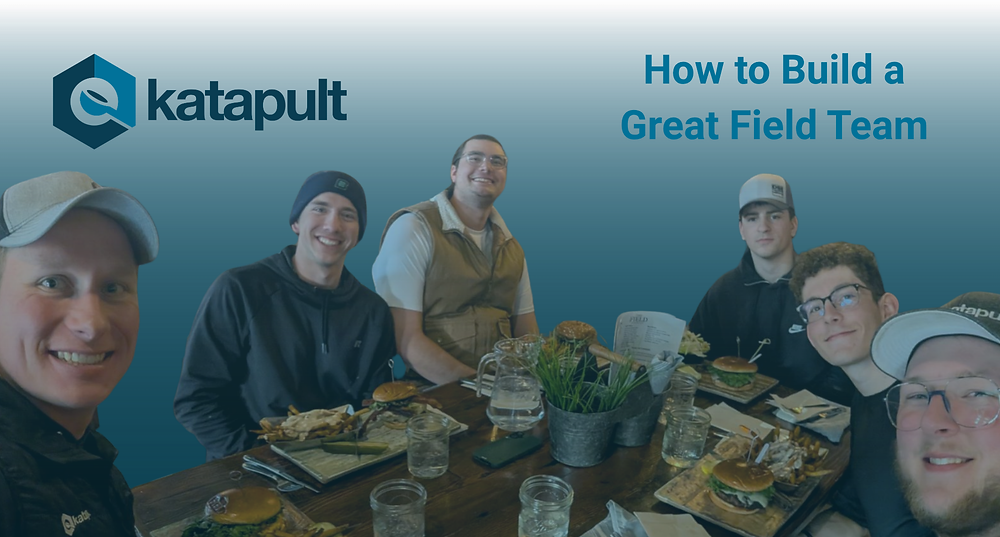
Here’s an inside look at how our engineering team harnesses killer field services as a competitive advantage. From KPIs and throughput to hiring, onboarding, weekly rhythms, safety, and more, we sat down with Seth Morris, our Field Services Team Lead, to better understand how your team can level up.
You already know data collection can make or break a project. Clean data from the field means clean designs, clean submissions, and clean margins. Bad data means rework, rollbacks, lost margins, and tough conversations with your customer.
The rest of the industry is struggling to find, train, and retain good field technicians. Turnover is high. Throughput is inconsistent. Quality is a coin flip. And with a flood of BEAD funds looming, demand is at an all-time high.
Our field team doesn’t seem to be struggling. They are thriving. So we sat down with Seth Morris, our Field Services Team Lead, to pull back the curtain on how and why they’re winning so that we can better support our software customers.
Whether you manage two fielders or 200, these principles apply.
Measure What Matters
Every great field team starts with knowing what "great" looks like. For Seth, that means tracking everything that moves the needle, and automating as much of it as possible.
"We have dashboards now, so it automatically tracks all of that and calculates our revenue as well as our profitability."
The team's primary scorecard is pole count, broken down by project type. But raw volume is only part of the story. Seth also tracks FCC compliance and a weekly quality bonus that ties real dollars to real performance.
The quality bonus has three components: weekly throughput, pickup rate, and a QC photo score from the photofirst team.
Something harder to measure on a scorecard? Poles per hour. If you manage field crews, you've probably debated poles-per-hour targets until you're blue in the face. Seth doesn't dodge the question.
"If we are in the city, I think 50 poles an hour is a good number to shoot for. You can hit 150 to 200 poles in a city day."
For country routes where poles are spread out and brush is a factor, expect 20 to 25 poles per hour, with 120 to 150 poles scheduled for the day. Backyards? About the same pace as country work, with adjusted expectations on mid-spans and access.
When Seth calculates poles/hour, he’s using firsthand data from his time in the field with each team member, as well as looking at the real-time progress of his teams in Katapult Pro.
This is tough to measure because of drive times, breaks, and working your way back to a trunk line when you’ve followed a branch out to the end. His targets are based on the time actually spent collecting field data.
These numbers aren't theoretical. They come from a team lead who rotates through every crew and sees the pace firsthand. These are the benchmarks Seth uses for hiring, coaching, and rewarding.
If your team is struggling to get up to those numbers, even on a continuous pole line, there's lots of room for improvement.
Hire for the Field, Not the Office
A great resume doesn't mean a great fielder. Seth has learned to look for traits that don't show up on paper.
"We have really good luck with landscapers and people from construction. They're used to being outside all day."
Physical fitness, comfort outdoors, and a willingness to grind through tough conditions are non-negotiable.
Seth evaluates candidates against Katapult's core values with a simple filter: is this person going to actively contribute to our culture, or just benefit from it?
And speaking of benefits, Seth mentioned one of the things that gives him pause in an interview.
"One thing is if they get too fixated on the benefits, like the field vehicle, the 36-hour work week, or meals in the field. Our benefits are just a means to an end. It's the people that make Katapult great, not those things."
The Player-Coach Model
This is where Katapult's field team separates itself from the pack. Seth isn't managing from a desk. He's in the field, rotating through every team member on a regular basis.
"I rotate around and field with everybody, so I see what their pace is like."
It takes about three months to cycle through the full team, but that rotation is what builds trust, catches problems early, and gives Seth an accurate read on each person's strengths and gaps. His more senior technicians extend that coaching capacity when Seth can't be everywhere at once.
When you've been in the field alongside your team, your feedback carries weight. When the person pushing you to grow is crawling through the thorns beside you, That's the player-coach advantage.
The Hybrid Approach
Most field technicians collect data and hand it off. They never see what happens downstream. Katapult does it differently.
"Our fielders also do all of their own pre-design. They spend three days in the field and one day in the office. They get exposure to the design team and they're expected to learn to look for things that make the next step easier."
This hybrid model (three days fielding, one day in the office doing pre-design) creates a field team that better understands the full workflow. They see what a missed anchor costs. They learn what designers need. And increasingly, they catch scope and safety issues in real time, before those issues become expensive problems.
We’ve seen field technicians who are brand new asking great questions and catching safety issues in real-time in the company-wide field chat.
If your fielders are "just collecting data," you're leaving quality and efficiency on the table.
Fast Feedback Loops
Annual reviews are important, but they’re not fast enough for field teams. By the time you address a pattern, the damage is done. Seth's team operates on rapid feedback cycles: daily, weekly, and quarterly.
The pickup dashboard is the backbone. When a designer flags a mistake, the fielder gets notified immediately. That pickup hits their quality score, which impacts their weekly bonus. The feedback loop is tight and the incentive is real.
"They are notified when they make a mistake that warrants a pickup, so that feedback loop is an incentive to make as few pickups as possible because their weekly bonus is determined by that."
Safety issues get addressed immediately, no exceptions. Quarterly conversations cover development, trends, and long-term growth. And when the team performs well? There's a tiered reward system.
"If we clear all the jobs for the week, I bring in donuts. If we hit our profitability target, I'll order coffees. If we hit both and hit our scorecards, we go out for lunch as a team on Friday."
Simple. Tangible. Weekly. That's how you keep momentum.
Safety Is Repetition, Not a Poster
You can post safety guidelines on the wall. They won't save anyone. Seth builds safety culture through constant, personal reinforcement.
"I've tried to instill in them that when it comes to electrical safety, it really is a matter of life and death."
When leadership practices what they preach, it sticks. Safety coaching happens weekly. It's woven into field rotations. And because Seth is in the field with his team, he gets to model his expectations and catch any concerns before it is too late or bad habits form.
Crowdsourced Field Support
Something unique about Katapult: when a fielder gets stuck, the whole company is on standby to help.
Real-time support isn't just a team lead responsibility. It comes from the whole business. And because almost everyone at Katapult has spent time in the field, the support is actually useful.
On any given Tuesday, a field technician might get a response within seconds from a software developer, a support technician, an executive, a PE, or a designer. Or all of the above.
Can't Hit These Numbers? Let's Talk.
If your field team isn't approaching these benchmarks, Seth's first question wouldn't be about your people. It would be about your process.
"I'd be curious what data they're trying to collect... I could probably pick out in 30 seconds, 'Oh, if you did this or this or this, that would probably make a big difference'"
Scope matters. A project requiring every single drop is going to move slower than a standard attachment survey. But within those constraints, there's almost always room to optimize.
The proof? Our training director, Trey Sobiech, provided a full week of training to a major ISP, and the results were strong enough that they flew their team out to Katapult twice more that year.
"I gave full-scope training over a week to their team. They ended up flying people out to us twice later in the year because it went really well. Their data looks pretty good." — Trey Sobiech
The Foundation
Building a great field team isn't about finding unicorns. It's about building systems: clear metrics, honest benchmarks, smart hiring, player-coach leadership, hybrid roles that create smarter technicians, fast feedback loops, relentless safety culture, and genuine team support.
This is how Katapult's engineering services team operates every day. It's also why our software, Katapult Pro, works the way it does. When your platform is built by people who actually do the work, it shows.
Want to learn more about you can level up your field services using Katapult Pro?
.png?width=680&height=1008&name=pole-no-bg%20(1).png)